Quick answer: Separation anxiety is a normal stage for most young children, and the NHS says it is common between 6 months and 3 years. It usually fades as your child grows. Get help if the fear is out of proportion to your child’s age, lasts for weeks, stops them going to school or sleeping alone, or keeps getting worse instead of better.
What is separation anxiety and at what age is it normal?
Separation anxiety is the fear a child feels when they are apart, or about to be apart, from the people they are closest to, usually a parent, grandparent or main carer. For babies and toddlers it is part of healthy growth. It shows your child has a strong bond with you.
The NHS describes it as common in young children between the ages of 6 months and 3 years. Children usually grow out of it, though it can last longer and can come back at times of stress, such as a new school, a house move or a new sibling.
So a three-year-old who cries through the early weeks of playschool is well within the usual range. What matters more than age is how big the fear is, how long it lasts and how much it gets in the way of daily life.
How is normal separation anxiety different from a disorder?
Separation anxiety disorder is the term used when the fear is far stronger than expected for the child’s age and does not ease with time. A review on the NIH’s NCBI Bookshelf (StatPearls) gives useful markers:
- Symptoms must last at least 4 weeks in children and teenagers before this is considered.
- The average age when the disorder starts is about 6 years, which is older than the usual baby and toddler stage.
- Population studies put it at about 4%, rising to 7.6% among children seen in clinics.
- An estimated 75% of children with the disorder show school refusal.
| What you notice | Usually a normal stage | Worth getting support |
|---|---|---|
| Age | Mostly 6 months to 3 years | Strong fear continuing into school age or beyond |
| How long it lasts | Eases within days or a few weeks of a change | Goes on for 4 weeks or more without easing |
| Crying at goodbye | Settles soon after you leave | Panic that lasts long after you have gone |
| School | Some reluctance in the mornings | Regular refusal to go, or frequent calls to come home |
| Sleep | Wants you nearby during a rough patch | Will not sleep without you, nightmares about being apart |
What are the signs your child may need help?
The NHS suggests talking to a professional if separation anxiety has gone on for more than a few weeks. Watch for:
- Refusing to go to school, tuition or a friend’s house because they do not want to leave you.
- Refusing to be alone in a room at home, or following you from room to room.
- Not being able to sleep unless you are next to them.
- Repeated nightmares about being separated.
- Stomach aches before school that a doctor finds no physical cause for.
- Worry that something bad will happen to you while you are away.
One sign on a hard week is not a cause for alarm. A pattern that keeps going, or that is shrinking your child’s world, is the time to act. You are also not alone: the CDC reports that in 2023–2024, 11% of US children aged 3 to 17 had current, diagnosed anxiety.
What can parents do at home to ease separation anxiety?
The NHS offers simple steps that many families find helpful:
- Practise short separations. Start by leaving your child with someone they trust for a few minutes, then slowly build up to longer times.
- Talk about what happens next. Tell your child what you will do together when you see them again, such as reading a story or having dinner.
- Leave something comforting. A small item that reminds them of you can help them feel safe.
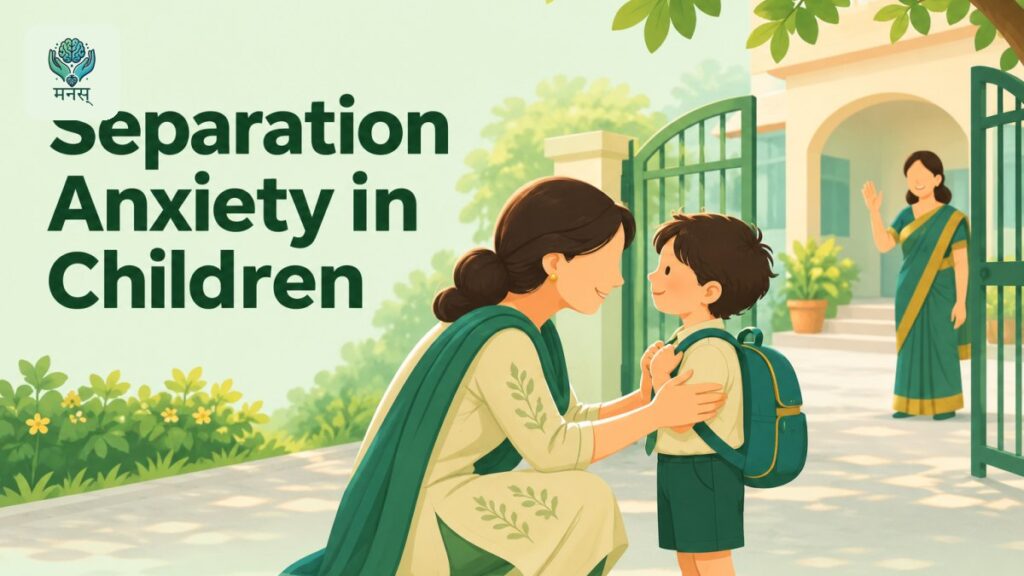
- Keep goodbyes short and positive. Smile and wave confidently. Long, tearful goodbyes or slipping away without telling them can make fear worse.
- Play games that show you come back. For babies, peek-a-boo is a simple way to teach that you always return.
A steady routine and praise for each small success also help. In joint families, ask grandparents and other carers to follow the same calm goodbye routine.
What does counselling for separation anxiety involve?
For anxiety in children, the NHS lists counselling and cognitive behavioural therapy (CBT) as the main options. CBT is a talking therapy that helps a child manage anxiety by changing the way they think and behave. The StatPearls review describes CBT as the first-line treatment for separation anxiety disorder.
With younger children, parents are usually closely involved, learning to plan gradual steps apart and to respond to tears in ways that build confidence. The NHS notes that medicines may be offered only if anxiety is severe or does not improve with talking therapies, and that is a decision for a doctor.
At Manas Center, family and parenting sessions are 60 minutes and work with children from age 6 upward, online across India or in person in Bhopal. A parent or guardian gives consent for anyone under 18.
Frequently asked questions
Yes, for most toddlers it is. The NHS says separation anxiety is common between 6 months and 3 years and that most children grow out of it. Short, calm goodbyes and practising brief separations usually help it ease over time.
If strong fear goes on for more than a few weeks, or is getting worse, it is worth talking to a professional. For a disorder to be considered in children, symptoms usually need to last at least 4 weeks and be out of proportion to age.
Yes. Although it is most common in young children, it can continue or appear later, often after a stressful change. The average age when separation anxiety disorder starts is about 6 years, so school-age children can be affected too.
It may be. An estimated 75% of children with separation anxiety disorder show school refusal. Other causes, such as bullying, should also be checked with the school.
It is usually better not to. Slipping away can make a child more watchful and anxious next time. The NHS advises saying goodbye confidently and happily, telling your child what you will do together later, and keeping the goodbye short.
Counselling can help many families. Cognitive behavioural therapy is described as the first-line treatment for separation anxiety disorder, and with younger children parents usually take part, learning steps they can practise at home between sessions.
Where can you get support for your child’s separation anxiety?
If your child’s fear of being apart from you has lasted for weeks or is affecting school or sleep, you do not have to manage it alone. A counsellor can help you make a clear, step-by-step plan.
You can read about our family and parenting counselling, look at teen and young adult counselling for teenagers, or book a session online or in Bhopal. If you have questions first, you can contact us.
Sources
- NHS: Separation anxiety
- NHS: Anxiety disorders in children
- Feriante J, Torrico TJ, McArthur J, Bernstein B. Separation Anxiety Disorder. StatPearls, NCBI Bookshelf (NIH)
- CDC: Data and Research on Children’s Mental Health
Plain-language guides on mental wellbeing, based on published research. Counselling at Manas Center is led by Dr. Priya Dubey Sharma, Founder & Consulting Psychologist.