Quick answer: OCD (obsessive compulsive disorder) is a mental health condition where unwanted, repeated thoughts, images or urges (obsessions) push you into repeated actions or mental acts (compulsions) to ease the distress. It is common, often starts around puberty or early adulthood, and responds well to a specific kind of talking therapy called CBT with exposure and response prevention.
What is OCD, in plain words?
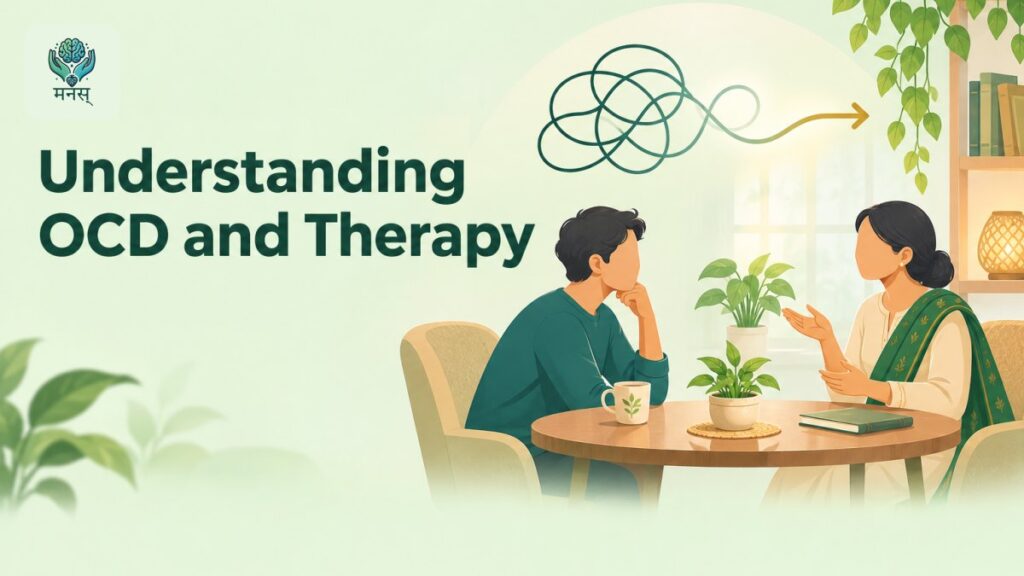
The NHS describes OCD as a mental health condition where a person has obsessive thoughts and compulsive behaviours. The two parts work like a loop.
- Obsession: an unwanted and unpleasant thought, image or urge that keeps entering your mind and brings anxiety, disgust or unease.
- Compulsion: a repetitive behaviour or mental act you feel you need to do to make that feeling go away for a while.
The relief is short. The next doubt arrives, and the loop starts again. The NHS gives the example of someone with an obsessive fear of being burgled who feels they need to check all the windows and doors are locked, again and again.
Being tidy or liking things a certain way is not OCD. NIMH notes that OCD symptoms are often time consuming and can cause significant distress or interfere with daily life. That interference is the key difference.
What are common obsessions and compulsions?
OCD looks different from person to person. The NHS symptoms page lists these as common patterns.
| Common obsessions | Common compulsions |
|---|---|
| Fear of contamination by disease, infection or an unpleasant substance | Cleaning and hand washing |
| Fear of harming yourself or others by mistake | Checking, for example that doors are locked or the gas is off |
| Fear of deliberately harming yourself or others | Asking for reassurance, or avoiding places and situations that trigger the thoughts |
| A need for symmetry or orderliness | Ordering and arranging, counting, or repeating words in your head |
Many compulsions are invisible. Silently repeating a phrase, re-reading a message ten times or mentally reviewing a conversation can all be part of the loop. Thoughts about harm are among the common obsessions, and they can be frightening. Talking about them with a trained professional is safe and is part of getting help.
How common is OCD, and when does it start?
OCD is more common than many people think. NIMH estimates that 1.2% of U.S. adults had OCD in the past year, and that lifetime prevalence among U.S. adults was 2.3%. Past-year prevalence was higher for women (1.8%) than for men (0.5%). These figures come from a large American survey; they give a sense of scale rather than an exact Indian number.
The NHS says OCD can affect men, women and children, that symptoms can begin as early as 6 years old, and that it often begins around puberty and early adulthood. NIMH found that about half of adults with OCD (50.6%) had serious impairment in daily life.
Does OCD go away on its own?
Usually not. The NHS says it is unlikely OCD will get better without proper treatment and support. NIMH adds that, although there is no cure, available treatments can help people manage their symptoms.
How does therapy help with OCD?
The NHS names 2 main treatments: talking therapy and medicine. Therapy for OCD is usually a type of cognitive behavioural therapy (CBT) with exposure and response prevention (ERP).
- Understanding the loop. You and the therapist map your obsessions, what triggers them, and what you do to get relief.
- Building a ladder. Together you list situations from mildly to strongly uncomfortable.
- Exposure, step by step. You face a lower step on purpose, with support.
- Response prevention. You practise not doing the compulsion and let the anxiety rise and fall by itself.
- Home practice. Short exercises between sessions turn progress in the room into progress in daily life.
It sounds hard, and at first it can be. The pace is agreed with you, never forced.
How many sessions will I need?
It depends on how much OCD affects your life. The NHS says people with fairly mild OCD usually need about 8 to 20 sessions of therapist treatment, with exercises done at home between sessions, and that it can take several months to notice the benefit. NICE guidance on OCD recommends low intensity psychological treatment, including ERP, of up to 10 therapist hours per patient when impairment is mild, and more intensive CBT of more than 10 therapist hours, or medicine, when it is greater.
Medicine is prescribed by a doctor, usually a psychiatrist, not by a counsellor. The NHS notes that you may need to take an SSRI antidepressant for up to 12 weeks before you notice any benefit, and that most people need treatment for at least a year. If you are already on medicine, therapy can work alongside it; never stop or change medicine without your doctor.
When should I get help?
The NHS advises speaking to a professional if you keep getting these thoughts and they have an effect on your daily life. Signs that it is time:
- Rituals are eating into your work, studies, sleep or family time.
- You avoid places, people or tasks because of the thoughts.
- Family members are drawn into checking or reassuring.
- You feel low, hopeless or exhausted by the fight.
If OCD often comes with worry and tension, our guide to what anxiety symptoms feel like may help you put words to it. If you ever feel unsafe or think you might harm yourself, call 112, India’s emergency number, or go to the nearest hospital emergency department now.
Frequently asked questions
No. Many people like order or cleanliness without any distress. OCD involves unwanted thoughts that cause real anxiety and repeated actions you feel you must do to ease it, often taking a lot of time and getting in the way of daily life.
Fear of harming yourself or others, by mistake or on purpose, is one of the common obsessions the NHS lists for OCD. Such thoughts can be very frightening. A trained therapist can help you understand them and respond without rituals or avoidance.
ERP is the core of CBT for OCD. You gradually face the thoughts or situations that trigger anxiety, in planned steps, while practising not doing the compulsion. Over time the anxiety tends to settle on its own and the urge loses its grip.
For fairly mild OCD, the NHS says about 8 to 20 sessions are usually needed, with home exercises in between. It can take several months to notice the benefit. More severe OCD may need more intensive therapy, sometimes with medicine prescribed by a doctor.
Yes. The NHS says symptoms can start as early as 6 years old, and OCD often begins around puberty and early adulthood. If a child’s rituals or fears are taking over routines or causing distress, speak to a doctor or a qualified mental health professional.
Yes. At Manas, sessions are 60 minutes and available online by video anywhere in India, or in person at Manas Center in Ayodhya Nagar, Bhopal. Exposure exercises can be planned and reviewed over video, with practice done at home between sessions.
Ready to talk about it?
You do not need to explain everything perfectly in the first session. Learn how individual counselling at Manas works, or book a 60-minute session online or in person in Bhopal.
Sources
- NHS: Obsessive compulsive disorder (OCD), overview
- NHS: OCD treatment
- NIMH: Obsessive-Compulsive Disorder statistics
- NICE guideline CG31 on obsessive-compulsive disorder: recommendations
Plain-language guides on mental wellbeing, based on published research. Counselling at Manas Center is led by Dr. Priya Dubey Sharma, Founder & Consulting Psychologist.