Quick answer: To support a struggling employee, notice the change early, ask privately and kindly how they are, listen more than you talk, and agree on one or two practical work adjustments. You are not there to diagnose or fix them. Your job is to make help easier to reach and work easier to manage while they recover.
Why should a manager step in, and what signs matter?
Mental health at work is not a small, private issue. The World Health Organization (WHO) estimates that 16% of working-age adults had a mental disorder in 2023. It also estimates that 12 billion working days are lost every year to depression and anxiety, at a cost of US$ 1 trillion a year in lost productivity.
Almost 60% of the world’s population is in work, so the workplace is often where distress shows first. Stepping in early does not mean prying. It means treating a drop in wellbeing like a back injury: something real that deserves a sensible, kind response.
No single sign proves anything. Look for a change from the person’s usual pattern that lasts more than a few days, such as:
- Work that was reliable becoming late, rushed or full of errors
- Arriving late, leaving early or taking more short-notice leave
- Pulling back from team chat, lunch or meetings
- Irritability, tearfulness or unusual sensitivity to feedback
- Looking tired most days, or mentioning poor sleep
- Saying things like “I can’t cope” or “what’s the point”
Note what you see at work, not guesses about what is wrong.
How do you start the conversation, and what should you say?
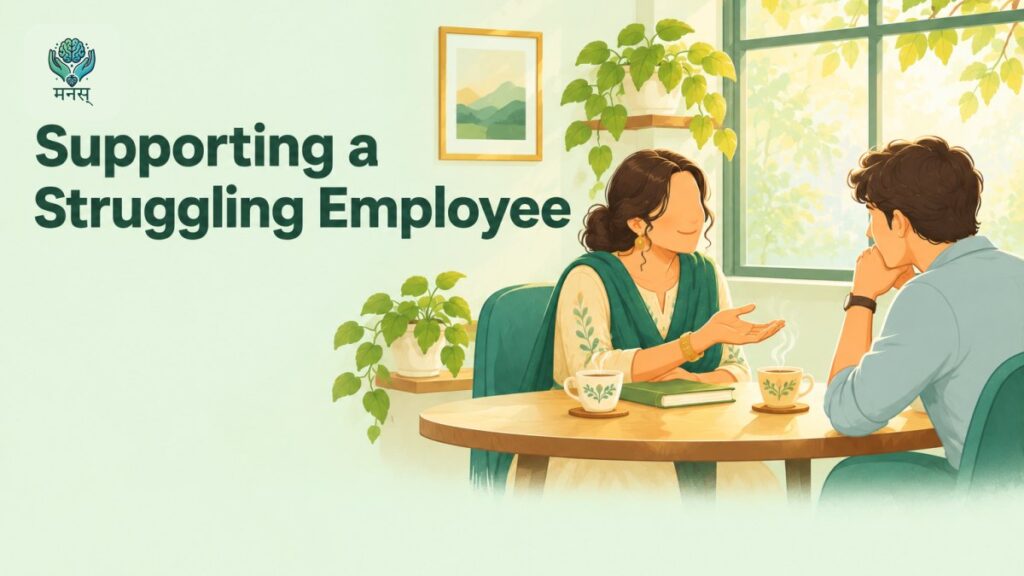
The UK’s National Institute for Health and Care Excellence (NICE), in its guideline on mental wellbeing at work (NG212), asks employers to train managers in “how to have a conversation on mental wellbeing with an employee, including at times of crisis.” In practice, a good first conversation looks like this:
- Choose a private moment. A closed room or a one-to-one video call, not the corridor.
- Open with what you have noticed. “You’ve seemed under a lot of pressure lately. How are you doing?”
- Listen without rushing to solve. Let them finish.
- Ask what would help. “What at work would make this week easier?”
- Agree a next step and a check-in date. Even a five-minute follow-up shows you meant it.
If they do not want to talk, accept that and check in again later. Small word choices change how safe a conversation feels:
| Helpful | Less helpful | Why it matters |
|---|---|---|
| “I’ve noticed you seem stretched. How are you?” | “Your performance has dropped. What’s wrong with you?” | Starting with care, not blame, keeps the person talking. |
| “Take your time.” | “Everyone gets stressed, just push through.” | Brushing it off tells them not to raise it again. |
| “What would make work more manageable right now?” | “I know exactly what you should do.” | They know their situation better than you do. |
| “This stays between us unless you’re at risk.” | “I’ll mention it to the team so they go easy on you.” | Sharing without consent breaks trust fast. |
| “Would it help to speak to a counsellor?” | “You should see a doctor, something’s clearly wrong.” | Offering options respects their choice. |
What work adjustments can actually help?
WHO describes reasonable accommodations as changes that “adapt working environments to the capacities, needs and preferences of a worker with a mental health condition.” Its examples include flexible hours, extra time for tasks, modified assignments, time off for health appointments and regular supportive meetings with supervisors.
NICE also asks employers to empower managers to adjust workload or work intensity. Many changes cost little: moving a deadline, sharing a large project or protecting time for counselling. Agree them together, write them down and set a review date. If someone has been on leave, WHO notes that return-to-work programmes combine work-directed steps, such as a phased return, with ongoing care.
Does training managers make a difference?
Evidence suggests it can. WHO’s guidelines on mental health at work, published on 28 September 2022, include manager training among their recommendations. WHO says this training helps managers recognise and respond to supervisees in emotional distress, and builds skills such as open communication and active listening.
When does it become urgent, and where are your limits?
You are a manager, not a counsellor. Your role is to notice, listen, adjust work and point the way to help.
It becomes urgent if an employee talks about ending their life, harming themselves, or seems unable to stay safe. Do not leave them alone. In India, call 112 (the national emergency number) or take them to the nearest hospital emergency department. Then tell HR, sharing only what is needed to keep the person safe.
For everything short of an emergency, offer clear routes to support: your Employee Assistance Programme if you have one, or a qualified counsellor the employee can see privately.
Frequently asked questions
Ask the employee first. Most conversations can stay between you, with only the agreed work changes shared. If there is a risk to their safety, involve HR and emergency help, sharing only what is needed to keep them safe.
Yes, if you ask privately and respectfully. Ask how they are doing and whether anything at work would help, rather than asking about a condition. Let them decide how much to share, and accept it if they would rather not talk.
Review the adjustments together and check whether they are realistic. Keep performance talks separate from wellbeing talks, stay factual, and record what was agreed. Support and fair expectations can go side by side; one does not cancel the other.
There is no fixed rule. Agree a review date, often a few weeks out, and adjust from there. Some changes are short term during a hard patch; others may be needed for longer. Regular check-ins keep the plan fair for everyone.
No. Your job is to make help easy to find, not to push it. Mention options such as your Employee Assistance Programme or a private counsellor, explain that sessions are confidential, and leave the decision with the employee.
That is common. Supporting a struggling colleague takes energy. Talk to your own manager or HR about workload, keep clear limits on your role, and consider counselling for yourself if the stress begins to affect your sleep, mood or work.
Need support for yourself or your team?
Manas Center offers 60-minute counselling sessions online by video anywhere in India, or in person at our center in Ayodhya Nagar, Bhopal. An employee can book privately through individual counselling, and managers can learn how workplace support schemes work in our Employee Assistance Programme guide.
To arrange a session, book a session or contact us with your questions.
Sources
- World Health Organization: Mental health at work (fact sheet)
- World Health Organization: Guidelines on mental health at work (28 September 2022)
- NICE NG212: Mental wellbeing at work, recommendations
Plain-language guides on mental wellbeing, based on published research. Counselling at Manas Center is led by Dr. Priya Dubey Sharma, Founder & Consulting Psychologist.