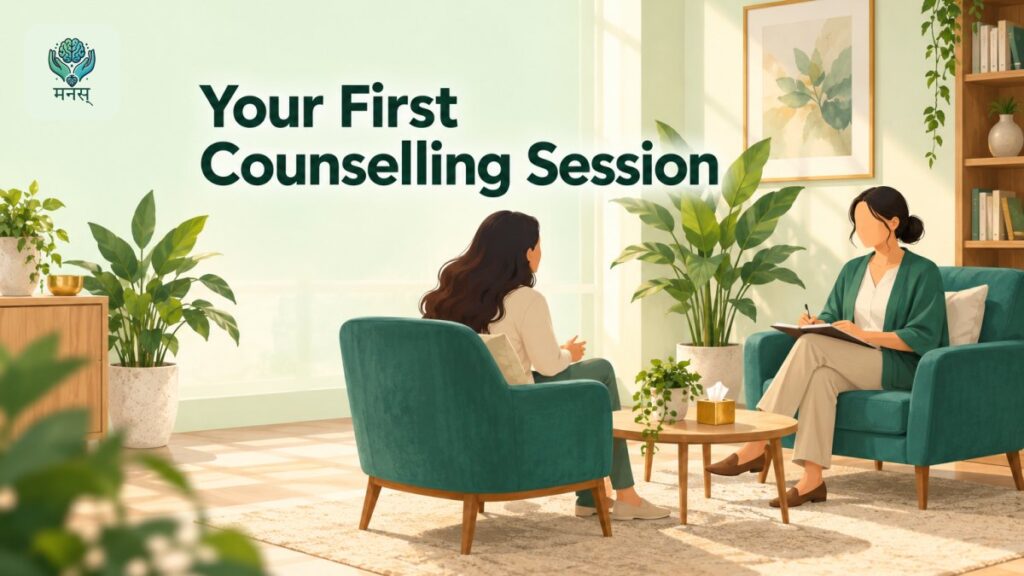
Quick answer: Your first counselling session is mostly a conversation. The psychologist asks what brought you in, how it is affecting your sleep, work and relationships, and what you hope will change. Together you agree on goals and a rough plan. You do not have to share everything at once, and you can ask questions at any point.
Booking a first appointment is often the hardest step. Many people put it off for months, not because things are fine, but because the session itself feels like an unknown. This guide walks you through what typically happens, so you can walk in, or log in, knowing what to expect.
What happens in the first few minutes?
The session usually opens with practical matters: introductions, how long the session runs (most last 45 to 60 minutes), fees, how to reschedule and how confidentiality works. You may be asked to fill a short intake form before or at the start, covering basic details, your current concerns and any support you have had in the past.
This is also a good moment to raise anything that worries you about the process itself, such as who will see your notes or whether sessions can be online.
What will the psychologist ask me?
Expect open questions rather than a test. A common opener is simply, “What brought you here today?” Other questions often include:
- Why did you decide to book now?
- How long has this been going on, and has it changed over time?
- How is it affecting your sleep, appetite, work or studies, and relationships?
- What have you already tried, and what helped even a little?
- Who supports you, and is anything at home or work adding pressure?
- What would be different in your life if counselling worked?
There are no right answers. “I am not sure” is a perfectly useful reply, and a good counsellor will help you find words for what you feel. According to the American Psychological Association, you will not be pushed to share anything you are not ready to discuss.
Is what I say kept confidential?
Yes. What you share stays between you and your psychologist. The narrow exceptions, which a counsellor should explain at the start, are situations where there is a serious risk of harm to you or someone else, or where the law requires disclosure. If you are unsure about anything, ask directly how notes are stored and who can see them. A good professional will be glad you asked.
How should I prepare for my first session?
You do not need to prepare much, but a little thought helps you get more from the hour:
- Write down two or three things you want help with. Rough notes on your phone keep you on track if you feel nervous.
- Notice recent changes. Shifts in sleep, appetite, energy or concentration over the past few weeks are useful to mention.
- List any medicines or past treatment. Your counsellor needs the full picture, even if something feels unrelated.
- Find a private spot for online sessions. Use headphones and a room where you will not be overheard.
- Consider a free screening first. A short validated questionnaire from our free assessments can give you and your psychologist a useful starting point.
Will I feel better after one session?
Some people feel lighter simply from being heard. Others feel tired or a little raw, because they have talked about things they usually keep inside. Both reactions are normal. Lasting change usually comes over several sessions, as you build skills, notice patterns and try new ways of responding.
The evidence is encouraging. The APA notes that in one classic study, half of psychotherapy patients improved after eight sessions and 75% improved after six months, and that the working relationship between you and your psychologist, often called the therapeutic alliance, is a key part of what makes therapy work. The US National Institute of Mental Health describes the main evidence-based approaches, such as cognitive behavioural therapy, if you want to read more.
What happens at the end of the first session?
Towards the end, your psychologist will usually summarise what they heard, suggest a focus for the next few sessions and agree a rhythm with you, often weekly to begin with. You may leave with a small task, like noticing when a worry shows up or keeping a short sleep log. If counselling alone is not the right fit, for example when a medical check-up is needed, a good counsellor will say so and help you find the right referral.
Online or in person: does it make a difference?
For most concerns, online sessions work well, as long as you have privacy and a steady connection. In-person sessions can suit people who find it easier to open up face to face, or who want a clear break from home. At Manas Center you can choose an in-person session in Bhopal or an online session from anywhere in India. Sessions are led by Dr. Priya Dubey Sharma, Founder & Consulting Psychologist.
What are the numbers to know?
| Session length | Most first sessions last 45 to 60 minutes; at Manas a session is 60 minutes |
|---|---|
| Progress | In a classic study cited by the APA, half of patients improved after 8 sessions and 75% after 6 months |
| Fee at Manas | From ₹1,200 per session, with a ₹500 deposit when you book |
| Need help now? | Manas is not an emergency service. In an emergency, call 112 or go to the nearest hospital emergency department. |
Frequently asked questions
No. You can book a counselling session directly. If you are already seeing a doctor, it can help to let them know you are starting counselling.
It is fine to say so. Fit matters a great deal in therapy, and changing counsellors is a normal part of finding the right support.
It depends on what you are working on. Some people come for a few focused sessions; others prefer longer support. You and your psychologist review progress together and adjust the plan.
Yes, if you want to. Many people come alone the first time, and couple or family sessions can be arranged when the concern involves others.
Manas is not an emergency service. In an emergency, call 112 or go to the nearest hospital emergency department.
Ready when you are
If you have been putting it off, this can be your first step. Book a first session in Bhopal or online, or start with a free assessment to put words to what you are feeling.
Sources
- American Psychological Association: Understanding psychotherapy and how it works
- National Institute of Mental Health: Psychotherapies
- World Health Organization: Mental health, strengthening our response
Plain-language guides on mental wellbeing, based on published research. Counselling at Manas Center is led by Dr. Priya Dubey Sharma, Founder & Consulting Psychologist.